Right Logo
Menu
⚙️ Complete Casting Engineering Platform
C3P Cast-Designer Software for
High Pressure Die-Casting
⚙️ Industry 4.0 Digital Foundry

Comprehensive HPDC Design, Simulation & Optimization

Across the Complete Casting Development Cycle: Cast-Designer is a complete Digital Foundry Engineering Platform that revolutionizes the casting development cycle. It integrates intelligent design-for-manufacturing, AI-driven optimization, advanced CFD/FEM simulation, metallurgical prediction, and production optimization into a single environment. From concept design and gating systems to microstructure analysis and Giga casting validation, Cast-Designer enables first-time-right manufacturing with unprecedented speed and accuracy.

🎨✏️
Design It Right Before Simulation
Design Stage
  • DFM Analysis (Hotspot / Wall thickness / Parting line)
  • Intelligent Gating Wizard & Smart Runner Generator
  • QuickCast™ Geometry Flow Assessment (minutes)
  • AI-based ingate & orientation optimization
  • Automatic Cooling System & Spray Cooling Design
  • Slider/Core & ejection force estimation
🔬📊
Predict Problems Before Production
Analysis Stage
  • Flow Filling (HPDC, Gravity, LPDC, GDC, tilt, etc.)
  • Solidification & Shrinkage Porosity (Niyama, SDAS)
  • Stress, Distortion & Hot Tearing Prediction
  • Air Entrapment, Oxide & Material Age Tracking
  • Mechanical Property & Fatigue Assessment
  • Mould erosion & temperature distribution
 🏭
Digital Foundry & Virtual Optimization
Advanced Stage
  • Cellular Automata Grain Structure & Microstructure
  • Full Mould Cyclic Analysis (real production cycles)
  • Shot Sleeve / Piston Movement & Core Gas Simulation
  • Heat Treatment & Casting Performance Validation
  • AI-Based Optimization (DOE, Genetic Algorithm)
  • Production Optimization: cycle time, spray strategy

🔧 Breakthrough technologies inside Cast-Designer

Integrated CFD/FEM + metallurgical + AI tools — uniting design, simulation, and real-world foundry intelligence.

⚡ QuickCast™ AI Pre-Design
Instant flow assessment from ingate positions — predicts flow coverage, air entrapment, dead zones in minutes, not hours. AI-driven ingate location optimization for first-time-right design.
Design Stage
🏭 Smart Runner Generator
Define ingate & biscuit location — software auto-generates full runner system with area reduction, draft angles, fillets, and balanced branches. Cuts design time from days to minutes.
Gating Wizard
🌡️ Full Mould Cyclic Analysis
Simulates actual production cycles: filling → cooling channels → die spray → multiple shots. Unmatched accuracy for thermal stabilization and realistic porosity prediction.
Advanced Stage
🌀 Cellular Automata Grain & SDAS
Predicts grain nucleation/growth, Secondary Dendrite Arm Spacing, ferrite/pearlite phases. Direct mechanical property estimation (UTS, elongation) from microstructure.
Metallurgical
🎯 AI Optimization & Genetic Algorithm
Target-oriented optimization: gating, runner, cooling, parameters. DOE + Taguchi + GA searching thousands of combos to minimize porosity, improve yield & thermal balance.
AI-Driven
📦 Casting Performance (Structural + Defects)
Unlike traditional FEA: includes porosity, gas holes, residual stress from casting process. Fatigue, failure prediction matches real-world casting behavior.
Validation
🔁 Shot Sleeve & Piston Simulation (HPDC)
Real piston motion, metal acceleration, air compression & sleeve filling. Essential for high-pressure die casting accuracy and defect-free filling.
HPDC Experts
🌬️ Core Gas & Core Blowing Simulation
Predicts core gas generation, movement, entrapment plus sand filling / compaction. Reduced gas porosity and superior core quality.
Advanced
❄️ Automatic AI Cooling Design
Generates cooling channels, spray layout, and thermal balancing in minutes. Cooling flow analysis + spray timing optimization for reduced cycle time and longer die life.
Thermal Management
🔥 Heat Treatment & Distortion
Simulate entire heat treatment cycles (heating, quenching, aging), microstructure evolution, residual stress changes — minimize trial runs and dimensional deviations.
Post-Processing
📐 Stress, Warpage & Hot Tearing
Integrated casting process stress analysis — includes thermal history, porosity influence, mold gap, residual stress prediction. Realistic distortion control.
Structural Integrity

🌐 Supported Casting Processes & Industry Solutions

HPDC LPDC Gravity Die Casting Investment Casting Tilt Casting Lost Foam Continuous Casting Centrifugal Casting GIGA Casting Semi-Solid Casting

Integrated CFD/FEM solvers + material generator (custom alloys), squeeze pin simulation, die thermal cycle analysis, and rapid DFM for any casting method.

“From Design-for-Manufacturing to AI-driven optimization and grain structure prediction — Cast-Designer transforms the complete casting lifecycle into a digital twin reality. Reduce trial castings, eliminate defects, and achieve first-time-right production.”
⚙️ Complete Digital Foundry Engineering Platform
Cast-Designer Software Capabilities
Across the Complete Casting Development Cycle

Integrated casting engineering platform — from concept design & manufacturability to AI-driven simulation, metallurgical prediction, and full production optimization.

🎨 Design It Right Before Simulation
Design Stage: Intelligent Manufacturing Engineering
AI-powered design-for-manufacturing, automated gating systems, instant flow assessment, and smart cooling — reducing design iterations from weeks to minutes.
⚡ 18+ intelligent design modules | First-time-right engineering
DFM Analysis Gating Wizard QuickCast AI Cooling Design Runner Gen
Flow Fluid Fraction
DFM Analysis

Hotspot Detection

Automated identification of isolated heavy sections that cool slowly and are prone to shrinkage porosity, sink marks, internal cavities, and distortion. Performed within minutes for rapid manufacturability feedback.

  • Shrinkage porosity zone prediction
  • Sink mark & cavity risk mapping
  • Distortion-prone region identification
  • Cooling imbalance alerts
🔥 Hotspot severity 📊 Cooling rate  ️ Shrinkage risk
Wall Thickness
DFM Analysis

Wall Thickness Analysis

Detects thin sections causing misruns and cold shuts, thick sections causing shrinkage, and non-uniform wall transitions that create turbulence, hotspots, and residual stresses.

  • Minimum thickness violation detection
  • Maximum thickness & section mapping
  • Abrupt transition identification
  • Better metal flow & uniform cooling
📏 Min/Max thickness 🔄 Transition grade ✅ Design rule check
Parting Line
DFM Analysis

Parting Line & Slider/Core Identification

Determines optimal die separation location for easier mould manufacturing, better casting extraction, and reduced flash formation. Automatically identifies undercuts, side cores, and slider requirements.

  • Optimal parting line recommendation
  • Undercut & side core detection
  • Slider requirement & count estimation
  • Simplified die design & reduced tooling cost
➖ Parting line 🔧 Slider count 💲 Tooling complexity
Slider Zone
DFM Analysis

Ejection Force & Core Extraction

Predicts force required to eject casting from die to prevent casting damage and optimize ejector pin design. Evaluates core removability and manufacturability to avoid trapped cores.

  • Ejection force estimation (N/mm²)
  • Ejector pin placement optimization
  • Core removability verification
  • Trapped core detection & resolution
⬆️ Ejection force 📌 Pin count ✅ Core manufacturability
Flow Fluid Fraction
Intelligent Gating

Gating Wizard

Built using decades of foundry knowledge and industry standards. Automatically recommends machine selection, biscuit dimensions, fill time, gate velocity, runner dimensions, ingate area, and runner area ratios.

  • Process-specific recommendations (HPDC/LPDC/Gravity)
  • Fill time & gate velocity optimization
  • Area ratio calculations (real foundry rules)
  • Faster development & reduced dependency on experience
⚡ Fill time 🎯 Gate velocity 📐 Area ratios
🏃🔧
smart_runner_generator.jpg
Auto runner · Area reduction
Intelligent Gating

Smart Runner Generator

Designer only defines ingate locations and biscuit location — software automatically generates complete runner system with area reduction rules, draft angles, fillets, branch runners, and main runner balancing.

  • Complete runner system in minutes
  • Automatic area reduction & balancing
  • Draft angles & fillets applied
  • Improved casting yield
⚙️ Design time: minutes 📐 Balanced runners 📈 Yield improvement
📚⚙️
gating_libraries.jpg
HPDC · LPDC · Gravity · Investment
Intelligent Gating

Predefined Gating Libraries

Comprehensive libraries for Gravity Casting, HPDC, LPDC, GDC, and Investment Casting. Proven design templates enable rapid project setup and standardized gating configurations.

  • Industry-standard template collection
  • Process-specific runner configurations
  • Customizable & expandable library
  • Reduced engineering setup time
📚 5+ processes ⚡ Rapid setup ✅ Proven designs
⚡🌀
quickcast_flow.jpg
Instant filling · Dead zones
QuickCast AI

QuickCast™ Flow Assessment

Geometry-based instant flow assessment without building complete runners or moulds. Users simply select ingate positions — predicts flow path, coverage, filling sequence, dead zones, air entrapment, and gas porosity tendency.

  • Results within minutes (not hours/days)
  • Early design validation without meshing
  • Dead zones & air entrapment mapping
  • Significant engineering time savings
⚡ Results: minutes 💨 Air entrapment 🎯 Flow coverage
 🎯
ai_predesign_opt.jpg
Ingate optimization · Balanced flow
QuickCast AI

AI-Based Pre-Design Optimization

Automatically optimizes ingate location, orientation, size, and metal distribution to achieve uniform filling, balanced flow, and reduced air entrapment — before detailed simulation begins.

  • Ingate position & angle optimization
  • Metal distribution balancing
  • Reduced simulation iterations
  • Better first-time-right design
🎯 Ingate placement ⚖️ Flow balance   AI-driven
🌡️⚡
fast_cooling_analysis.jpg
Temperature map · Hotspot regions
Cooling Design

Fast Cooling Analysis

Rapid thermal assessment of the casting providing temperature maps, hotspot regions, and cooling imbalance identification. Enables early thermal validation before detailed cooling design.

  • Temperature distribution mapping
  • Hotspot & cold spot identification
  • Cooling uniformity assessment
  • Early thermal feedback in minutes
🌡️ Temp map 🔥 Hotspot index ⚖️ Balance score
❄️  
ai_cooling_design.jpg
Auto channels · Thermal balance
Cooling Design

Automatic AI Cooling Design

Automatically generates cooling channels, cooling layouts, and thermal balancing strategies. Complete cooling system designed in minutes — dramatically reducing die design effort.

  • AI-generated channel placement
  • Thermal balance optimization
  • Reduced die design time (hours→minutes)
  • Improved cooling efficiency
❄️ Auto channels ⚡ Design speed 🌡️ Thermal balance
🔧📈
cooling_optimization.jpg
Efficiency · Uniformity · Cycle time
Cooling Design

Cooling Design Optimization

Further improves cooling efficiency, temperature uniformity, and cycle time. Increases productivity and extends die life through optimized thermal management.

  • Cooling channel parameter tuning
  • Temperature uniformity optimization
  • Cycle time reduction analysis
  • Die thermal fatigue mitigation
📈 Efficiency gain ⏱️ Cycle reduction 🔧 Die life extension
⚡ Integrated Simulation Technology

Advanced CFD Flow & FEM Solidification & Stress

Cast-Designer combines advanced CFD flow simulation with FEM-based solidification and stress analysis, delivering highly accurate prediction of the complete casting process — from filling to final part performance.
🌊🌀
CFD Flow Simulation

Advanced CFD Flow

The CFD solver accurately captures molten metal behavior, including free-surface flow, turbulence, air entrapment, oxide formation, pressure distribution, and complex filling dynamics — critical for high-quality casting design.

  • Free-surface tracking & turbulence modeling
  • Air entrapment & oxide formation prediction
  • Pressure distribution & velocity profiles
  • Non-Newtonian & semi-solid flow capabilities
❄️📐
FEM Solidification & Stress

FEM Solidification & Stress

The FEM solidification solver provides precise thermal analysis, predicting temperature gradients, cooling rates, solidification sequence, and shrinkage defects. Its coupled thermo-mechanical FEM analysis evaluates residual stresses, distortion, hot tearing, and mould gap formation.

  • Temperature gradients & cooling rate prediction
  • Shrinkage porosity & Niyama micro-porosity
  • Residual stress & distortion analysis
  • Hot tearing & mould gap formation
🔗
Integrated CFD-FEM Approach
Handles extremely large models including Giga castings — enabling foundries to optimize gating and cooling design, minimize defects, reduce trial castings, and achieve superior casting quality with shorter development cycles.
🚀 300M+ elements
🔬 Predict Problems Before Production

Analysis Stage: Comprehensive Simulation Suite

Every critical casting phenomenon modeled — from flow dynamics & solidification to stress, microstructure & performance. Each capability is expanded as an independent analysis module with dedicated result visualization (4:3 imagery).
📊 12+ dedicated analysis modules
CFD/Flow Solidification Stress/Distortion Microstructure Thermal Performance
🌊🌀
flow_filling_01.jpg
Metal front · Velocity vectors
Flow Simulation

Flow Filling Analysis

Full filling behavior prediction: fluid fraction, temperature evolution, velocity contours, turbulence zones, and air entrapment. Supports HPDC, Gravity, LPDC, GDC, tilt, investment, lost foam, and more.

  • Air entrapment & oxide prediction
  • Material age & flow trace lines
  • Mould erosion / cold shuts & misruns
⏱️ Fill time 🌡️ Temp distribution 💨 Gas porosity risk
❄️🔍
solidification_shrinkage.jpg
Niyama · Last-to-solidify zones
Solidification

Solidification & Shrinkage Porosity

Temperature evolution, solid fraction, cooling rates, thermal modulus. Advanced Niyama criterion for micro-porosity, macro shrinkage cavities, and SDAS prediction.

  • Macro shrinkage & internal cavities
  • Niyama micro-porosity mapping
  • Feeding requirement identification
🧊 Solid fraction 📉 Cooling rate 🕳️ Porosity index
📏🔬
SDAS_property.jpg
Dendrite arm spacing · UTS
Metallurgical

SDAS & Mechanical Properties

Secondary Dendrite Arm Spacing prediction from local solidification conditions. Direct estimation of Ultimate Tensile Strength (UTS) and elongation — virtual quality assessment without test castings.

  • Strength & ductility mapping
  • Correlation with cooling rate
  • Metallurgical quality index
💪 UTS [MPa] 📈 Elongation % 🔬 SDAS [µm]
📐⚙️
stress_distortion.jpg
Residual stress · Warpage
Stress & Distortion

Residual Stress & Distortion

Integrated casting process stress simulation (not generic FEA). Includes thermal history, phase transformations, mould gap effects. Predicts locked-in stresses, warpage, and final dimensional deviations.

  • Hot tearing & crack susceptibility
  • Mould / casting gap analysis
  • Quench & age distortion
📏 Warpage [mm] 🔥 Hot tearing risk 🔧 Residual stress
🔄🔩
fatigue_performance.jpg
Defect-based fatigue life
Performance Validation

Fatigue & Casting Performance

Virtual validation of finished castings under service loads. Unlike traditional FEA, it integrates porosity, gas holes, residual stresses, and actual casting defects to predict fatigue life and failure.

  • Cyclic loading / SN-curves
  • Failure probability with defects
  • Structural + thermal combined
⚙️ Fatigue cycles 🧪 Failure index 📊 Safety factor
💨🫧
air_entrapment_oxide.jpg
Bubble tracking · Bifilm index
Flow Defects

Air Entrapment & Oxide Prediction

Quantifies air pockets, bubble movement, and oxide film formation due to turbulent flow. Critical for reducing gas porosity, surface defects, and improving structural integrity.

  • Air pressure & entrapment zones
  • Oxide / bifilm index
  • Venting optimization guidance
🫧 Air concentration 🌊 Turbulence zones 🧪 Oxide risk map
🌡️🔥
mould_thermal.jpg
Die temperature · Erosion
Thermal

Mould Thermal & Erosion Analysis

Predicts die / mould temperature distribution, hot spots, and erosion-prone regions. Enables optimized cooling channel layout and reduced thermal fatigue.

  • Mould erosion severity
  • Cycle-to-cycle die stability
  • Cooling efficiency index
🔥 Hotspot map ⏲️ Cooling rate 🧱 Erosion risk
🔫⚙️
shot_sleeve_hpdc.jpg
Piston motion · Air compression
HPDC Advanced

Shot Sleeve & Piston Simulation

Realistic simulation of slow shot, fast shot, piston movement, metal acceleration, and air compression inside the sleeve. Essential for high-pressure die casting process setup.

  • Air entrapped in sleeve
  • Wave & velocity profiles
  • Optimized biscuit/plunger
📈 Plunger speed 💨 Air compression 🔁 Sleeve filling
🌬️🧪
core_gas_simulation.jpg
Gas generation · Vent efficiency
Core & Venting

Gas & Venting Effectiveness

Predicts trapped gas and movement through the mould, and venting efficiency. Reduces gas porosity defects and improves casting quality.

  • Pressure build-up prediction
  • Vent placement optimization
  • Gas output in each vent vs time
🌫️ Gas concentration 💨 Vent flow rate 🔧 Core permeability
🔥⚙️
heat_treatment_solution.jpg
Solution · Aging · Quench
Post-Processing

Casting Heat Treatment Simulation

Virtual simulation of solution treatment, quenching, and aging cycles. Predicts microstructure evolution, residual stress changes, and final mechanical properties after heat treatment.

  • Quench distortion & residual stress
  • Phase transformation kinetics
  • Aging response & hardness
⏲️ Soaking time ❄️ Quench severity 📈 Hardness profile
🧪🌀
semi_solid_thixo.jpg
Thixo-moulding · Non-Newtonian flow
Semi-Solid Casting

Semi-Solid Modeling & Thixo-Moulding

Advanced simulation for semi-solid metal casting processes with critical small process windows. Supports non-Newtonian flow models and multiple material models for thixo-moulding and low solid fraction magnesium alloy casting.

  • Non-Newtonian viscosity & shear-thinning behavior
  • Temperature control within ±5°C process window
  • Local fraction solid & temperature evolution during fill
  • Melt viscosity & flow velocity mapping
🌡️ Process window: 10°C 🧪 Fraction solid 📊 Viscosity map ⚡ Flow velocity
🏗️🔩
giga_casting.jpg
Giga casting · Large-scale simulation
GIGA Casting

Giga Casting Simulation & Design

Dedicated tools for large-scale automotive castings (body structures, battery enclosures, eAxles, humanoid robots). Powerful meshing, multicore processing, and specialized design tools for giga casting development.

  • FastMesh engine: complex mesh with small feature snap & curvature accuracy
  • 300M FEM elements on 128GB RAM · Mixed mesh types
  • SmartCooling: AI-driven cooling channel design in few clicks
  • Cast-Works solver: parallel computing for thermal, flow & stress
  • Mould set stress & distortion analysis for huge FEM models
🏗️ Giga casting ⚡ 300M elements 🧊 FastMesh 📐 DCS compensation
  Digital Foundry & Virtual Production Optimization

Advanced Stage: Metallurgical Depth & AI Production Intelligence

Beyond traditional simulation — grain structure prediction, full cyclic production, AI-driven optimization, heat treatment, casting performance, and complete virtual process integration.
🚀 15+ advanced modules | Industry 4.0 ready
Microstructure AI Optimization Cyclic Analysis Heat Treatment Performance Core/Gas
🌾🔬
cellular_automata_grain.jpg
Grain nucleation & dendritic growth
Metallurgical Prediction

Cellular Automata Grain Structure

Predicts microscopic grain nucleation, dendritic growth, and final grain morphology during solidification. Outputs grain size distribution, columnar-to-equiaxed transition, and local crystallographic texture.

  • Grain size & morphology maps
  • Columnar-to-equiaxed transition (CET)
  • Ferrite / pearlite phase evolution
  • Local density variations
🌾 Grain size [µm] 🧪 Phase fraction 📈 Dendrite arm spacing
🔄🏭
full_mould_cyclic.jpg
Multi-cycle die thermal behavior
Production Reality

Full Mould Cyclic Analysis

One of the most advanced capabilities — simulates actual production cycles including filling, cooling channels, die heating, die spray, and multiple consecutive shots. Predicts thermal stabilization, cycle-to-cycle variation, and realistic porosity under steady-state production.

  • Warm-up cycles & steady-state equilibrium
  • Spray cooling effectiveness per cycle
  • True die thermal balance & hot spots
  • Cycle time optimization insights
🌡️ Stabilization time 💧 Spray strategy 📊 Cycle index
 🎯
ai_optimization_genetic.jpg
GA + DOE · multi-objective
Artificial Intelligence

AI-Based Optimization Platform

Target-oriented optimization using Genetic Algorithms, DOE, and Taguchi methods. Automatically optimizes gating design, runner dimensions, cooling system layout, and process parameters to reduce porosity, improve filling, increase yield, and enhance thermal balance.

  • Genetic Algorithm (GA) searching thousands of combos
  • Design of Experiments (DOE) automated workflows
  • Multi-objective Pareto optimization
  • Production parameter tuning (cycle time, spray)
🎯 Porosity reduction ⚡ Yield improvement 🔥 Thermal balance
🔫⚙️
shot_sleeve_piston.jpg
Plunger motion · Air compression
HPDC Specialist

Shot Sleeve & Piston Simulation

Realistic simulation of slow shot, fast shot, piston movement, metal acceleration, wave dynamics, and air compression inside the shot sleeve. Critical for high-pressure die casting process setup and defect reduction.

  • Air entrapment in sleeve during fill
  • Velocity & wave profiles optimization
  • Biscuit dimension & plunger tip design
  • Transition point optimization
📈 Plunger speed 💨 Air compression ratio 🔁 Sleeve filling pattern
🔥⚙️
heat_treatment_simulation.jpg
Solution · Quench · Aging
Post-Processing

Casting Heat Treatment Simulation

Virtual simulation of complete heat treatment cycles: solution treatment, quenching, and aging. Predicts microstructure evolution, residual stress changes, distortion, and final mechanical properties after thermal processing.

  • Quench distortion & residual stress evolution
  • Phase transformation kinetics (T6, T5, etc.)
  • Aging response & hardness profile
  • Reduced physical heat treatment trials
⏲️ Soaking time ❄️ Quench severity 📈 Hardness profile
📊⚙️
casting_performance_fatigue.jpg
Defect-integrated structural analysis
Validation

Casting Performance Simulation

Virtual validation of finished casting under service loads — uniquely integrates porosity, gas holes, residual stresses, and actual casting defects. More realistic than traditional FEA with direct correlation to real-world failures.

  • Structural analysis with defect mapping
  • Thermal-mechanical fatigue prediction
  • Failure probability & crack initiation
  • Certification-ready performance reports
💪 UTS / Yield 🔄 Fatigue cycles 🧪 Failure index
🧬🔍
microstructure_phase.jpg
Ferrite · Pearlite · Phases
Metallurgical

Microstructure & Phase Analysis

Predicts evolution of ferrite, pearlite, bainite, and other phases during solidification and cooling. Provides local density variations and phase fractions for accurate property estimation.

  • Phase fraction & distribution maps
  • Local density & micro-shrinkage correlation
  • Carbon equivalent & hardenability
  • Better porosity & strength estimation
🔬 Phase % 📊 Density variation 🧪 Micro-segregation
🧪📦
custom_material_generator.jpg
Proprietary alloy builder
Materials Innovation

Custom Material Generator

Create proprietary alloys by defining chemical composition. Automatically generates thermodynamic properties, phase diagrams, and complete material database entries for simulation of new alloy development.

  • Define custom alloy chemistry
  • Generate thermophysical properties
  • Phase diagram & solidification range
  • Seamless integration into simulation
📊 Composition 🔥 Liquidus/Solidus 🧪 Property database
📍🔧
squeeze_pin_simulation.jpg
Local feeding · Porosity elimination
Defect Mitigation

Squeeze Pin Simulation

Predicts effectiveness of squeeze pins in feeding localized shrinkage zones and eliminating porosity. Optimizes pin location, actuation timing, and pressure for improved casting integrity.

  • Localized feeding efficiency
  • Pin activation timing optimization
  • Pressure distribution mapping
  • Porosity reduction validation
📍 Pin placement ⏱️ Activation timing 🕳️ Porosity reduction
⏱️🏭
production_optimization.jpg
Cycle time · Spray strategy
Manufacturing Efficiency

Production Optimization

Optimizes cycle time, cooling duration, spray strategy, and die thermal balance for maximum productivity. Reduces manufacturing cost while maintaining casting quality.

  • Cycle time reduction analysis
  • Spray timing & intensity optimization
  • Die life extension through thermal balance
  • OEE (Overall Equipment Effectiveness) improvement
⏱️ Cycle time 💧 Spray efficiency 📈 Productivity gain
🧬🎯
genetic_algorithm_ga.jpg
Pareto front · Multi-parameter
AI Advanced

Genetic Algorithm (GA) Optimization

Searches thousands of design combinations automatically using evolutionary algorithms. Faster convergence to optimal gating, runner, and process parameter designs with multi-objective trade-off analysis.

  • Multi-objective Pareto optimization
  • Automated design space exploration
  • Convergence to global optimum
  • Integration with DOE & machine learning
🧬 Generations 📊 Pareto frontier ⚡ Convergence rate
📊🔬
doe_taguchi.jpg
Design of Experiments matrix
Statistical Optimization

DOE & Taguchi Optimization

Performs automated Design of Experiments to identify optimal process windows. Taguchi methods for robust design — finds parameter settings that minimize defect sensitivity to variations.

  • Main effects & interaction analysis
  • Signal-to-noise ratio optimization
  • Process capability prediction
  • Reduced physical trials (up to 80%)
📐 Orthogonal array 📈 S/N ratio 🎯 Robust design
💧🌊
spray_cooling_design.jpg
Spray pattern · Heat extraction
Thermal Control

Spray Cooling Design & Optimization

Design and optimization of spray locations, timing, intensity, and pattern for die thermal management. Achieves better thermal stability, reduced cycle time, and improved casting quality.

  • Spray nozzle placement & angle
  • Flow rate & intermittent spraying
  • Heat extraction efficiency
  • Thermal fatigue reduction
💧 Spray coverage 🌡️ Temperature drop ⏲️ Cooling uniformity
💧🔁
cooling_flow_analysis.jpg
Coolant velocity · Heat transfer
Thermal Fluid

Cooling Flow Analysis

Evaluates coolant performance in cooling channels: flow velocity, heat extraction rate, residence time, and pressure drop. Optimizes channel layout for maximum thermal management efficiency.

  • Coolant velocity & turbulence
  • Heat transfer coefficient mapping
  • Residence time & temperature rise
  • Channel geometry optimization
💧 Flow rate 🌡️ Delta T coolant 📊 Heat flux
⬆️🔨
part_ejection_simulation.jpg
Ejection force Core friction Contact pressure
Production Cycle

Part Ejection Simulation

Full mould stress simulation including solidification + stress analysis - predicts ejection forces, friction behavior, and potential part damage during the ejection stage. Critical for quality parts and ejector pin optimization.

  • Full mould or solid shell stress model
  • Contact pressure & friction coefficient modeling
  • Static friction at extraction moment
  • Shrinkage onto core & friction properties
  • Ejector pin force & placement optimization
  • Part distortion & damage risk assessment
⬆️ Ejection force 🔧 Friction coefficient 📐 Contact pressure ⚠️ Damage risk
🔬 Virtual Casting Lab — Complete Simulation Outputs
Simulation Results Gallery

Every critical simulation result from Cast-Designer: Flow, Solidification, Stress, and Micro-Structure.

🌊🌀

Flow Simulation Results

17 outputs
Flow Fluid Fraction - Metal front advancement and fill pattern
Flow
Flow Fluid Fraction
Tracks metal front advancement and filling sequence. Identifies incomplete fill zones and filling pattern uniformity.
🌡️
flow_temperature.jpg
Temperature distribution during fill
Flow
Flow Temperature
Predicts premature solidification, cold shuts, and misruns. Critical for thin-wall casting validation.
flow_velocity.jpg
Velocity vectors & turbulence
Flow
Flow Velocity & Directions
Velocity contours, flow vectors, and turbulence zones. Identifies regions of jetting, splashing, or calm filling.
📊
flow_pressure.jpg
Pressure distribution · Air pressure
Flow
Flow Pressure & Max Air Pressure
Pressure distribution during filling and maximum air pressure peaks that can cause blowholes or die damage.
🫧
gas_entrapment.jpg
Air pockets · Bubble movement
Flow
Gas Entrapment & Bubble Movement
Shows air pockets, bubble movement, and entrapped gas locations leading to porosity defects.
material_age_oxide.jpg
Flow length · Age · Oxides
Flow
Flow Length, Material Age & Oxides
Tracks residence time of molten metal and predicts oxide formation due to turbulent flow.
🎨
ingate_colors.jpg
Multi-color ingate contribution
Flow
Flow In Each Ingate In Colours
Color-coded visualization of metal contribution from each ingate for flow balance assessment.
〰️
trace_lines.jpg
Particle traces · Flow paths
Flow
Flow Material Trace Lines
Visualizes individual metal particle movement paths to identify flow convergence and dead zones.
💨
gas_surface_internal.jpg
Surface & internal gas mapping
Flow
Gas Entrapped Inside & At Surface Level
Differentiates between surface gas porosity and internal gas entrapment for targeted mitigation.
📈
velocity_graph.jpg
Velocity vs time chart
Flow
Flow Velocity Graphs Vs Time
Quantitative velocity evolution at critical locations or ingates over filling duration.
📉
temperature_graph.jpg
Temperature vs time chart
Flow
Flow Temperature Graphs Vs Time
Temperature decay curves during filling to identify premature solidification risks.
⏱️
filling_time.jpg
Total fill duration map
Flow
Filling Time
Complete filling duration evaluation — ensures fill time within recommended process window.
🧱
mould_erosion.jpg
Erosion risk map
Flow
Mould Erosion
Identifies erosion-prone regions caused by high-velocity metal impact on mould/die surfaces.
🔬 Virtual Casting Lab — Complete Simulation Outputs
Simulation Results Gallery

Every critical simulation result from Cast-Designer: Flow, Solidification, Stress, and Micro-Structure.

❄️🔬

Solidification Results

14 outputs
🧊
solid_fraction.jpg
Mushy zone · Freezing sequence
Solidification
Solid Fraction
Shows mushy zones and freezing sequence — critical for feeding path identification.
🌡️
solidification_temp.jpg
Temperature evolution
Solidification
Solidification Temperature
Temperature evolution during solidification — identifies liquid-to-solid transition zones.
🏭
casting_mould_temp.jpg
Casting & die temperature
Solidification
Casting & Mould Temperature
Simultaneous temperature tracking of casting and mould/die for thermal interaction analysis.
📐
thermal_modulus.jpg
Modulus · Cooling rate
Solidification
Thermal Modulus & Cooling Rate
Identifies feeding requirements and local cooling characteristics for microstructure control.
⏲️
solidification_time.jpg
Total freezing duration
Solidification
Solidification Time
Total freezing time map — last-to-solidify regions indicate shrinkage risk areas.
🕳️
shrinkage_niyama.jpg
Macro/micro porosity
Solidification
Shrinkage Porosity & Niyama Micro Porosity
Advanced Niyama criterion for micro-shrinkage plus macro shrinkage cavity prediction.
🌾
sdas_dendrite.jpg
Dendrite arm spacing
Solidification
SDAS & Dendrite Arm Spacing
Secondary Dendrite Arm Spacing prediction — key metallurgical quality indicator.
💪
uts_elongation.jpg
Strength · Ductility
Solidification
Ultimate Tensile Strength & Elongation
Direct mechanical property prediction from solidification conditions — virtual quality assessment.
📦
piping.jpg
Pipe shrinkage cavity
Solidification
Piping
Visualizes open pipe shrinkage cavities — critical for riser and feeder design validation.
📍
pin_squeeze.jpg
Local feeding effectiveness
Solidification
Pin Squeeze Analysis
Predicts effectiveness of squeeze pins in feeding shrinkage zones and eliminating porosity.
📊
temp_graphs_solid.jpg
Cooling curves
Solidification
Temperature Graphs
Cooling curves at critical locations — phase transformation and solidification kinetics.
🔬 Virtual Casting Lab — Complete Simulation Outputs
Simulation Results Gallery

Every critical simulation result from Cast-Designer: Flow, Solidification, Stress, and Micro-Structure.

📐⚙️

Stress & Distortion Results

7 outputs
📏
distortion.jpg
Deformed vs nominal shape
Stress
Distortion / Displacement
Final dimensional deviations — overlay of deformed vs nominal casting geometry.
🔄
compensation.jpg
Pre-deformed tool design
Stress
Compensation For Distortion
Automatically computes pre-deformed geometry to achieve net shape after casting distortion.
📊
stress_effective.jpg
Normal & von Mises stress
Stress
Normal Stress & Effective Stress
Normal stress components and von Mises effective stress for failure assessment.
🔒
residual_stress.jpg
Locked-in stresses
Stress
Residual Stress
Predicts locked-in stresses after solidification and cooling — critical for machinability.
🔄
fatigue.jpg
Cyclic life prediction
Stress
Fatigue
Fatigue behavior prediction considering porosity, residual stress, and thermal history.
mould_gap.jpg
Casting/die separation
Stress
Mould Gap
Evaluates separation between casting and die — affects cooling rate and distortion.
🔥
hot_tearing.jpg
Crack susceptibility
Stress
Hot Tearing
Predicts crack formation during solidification — high-risk zones for hot tearing defects.
🔬 Virtual Casting Lab — Complete Simulation Outputs
Simulation Results Gallery

Every critical simulation result from Cast-Designer: Flow, Solidification, Stress, and Micro-Structure.

🔬🧬

Micro-Structure Results

3 outputs
⚙️
ferrite.jpg
Ferrite phase distribution
Micro-Structure
Ferrite
Predicts ferrite phase fraction and distribution — influences ductility and magnetic properties.
💎
hardness.jpg
Hardness map (HB/HRC)
Micro-Structure
Hardness
Local hardness prediction from phase fractions and cooling rates — maps Brinell/Rockwell values.
🌾
grain_radius.jpg
Grain size distribution
Micro-Structure
Grain Radius
Cellular automata grain radius prediction — grain size distribution for mechanical property estimation.
Complete Coverage — 41+ simulation output types across Flow, Solidification, Stress, and Micro-Structure. Every result is automatically generated from Cast-Designer's integrated CFD/FEM/metallurgical solvers.

Cast-Designer for HPDC - Gating Design Features

Gating Design Wizards
QuickCast Flow Simulation
QuickCast Flow vs CFD Flow
SmartRunner Design
3D Runner Projection
FastCooling Simulation
SmartCooling System Design
Media Flow in Cooling Channels
Die Spray Optimization
Part Ejection Simulation

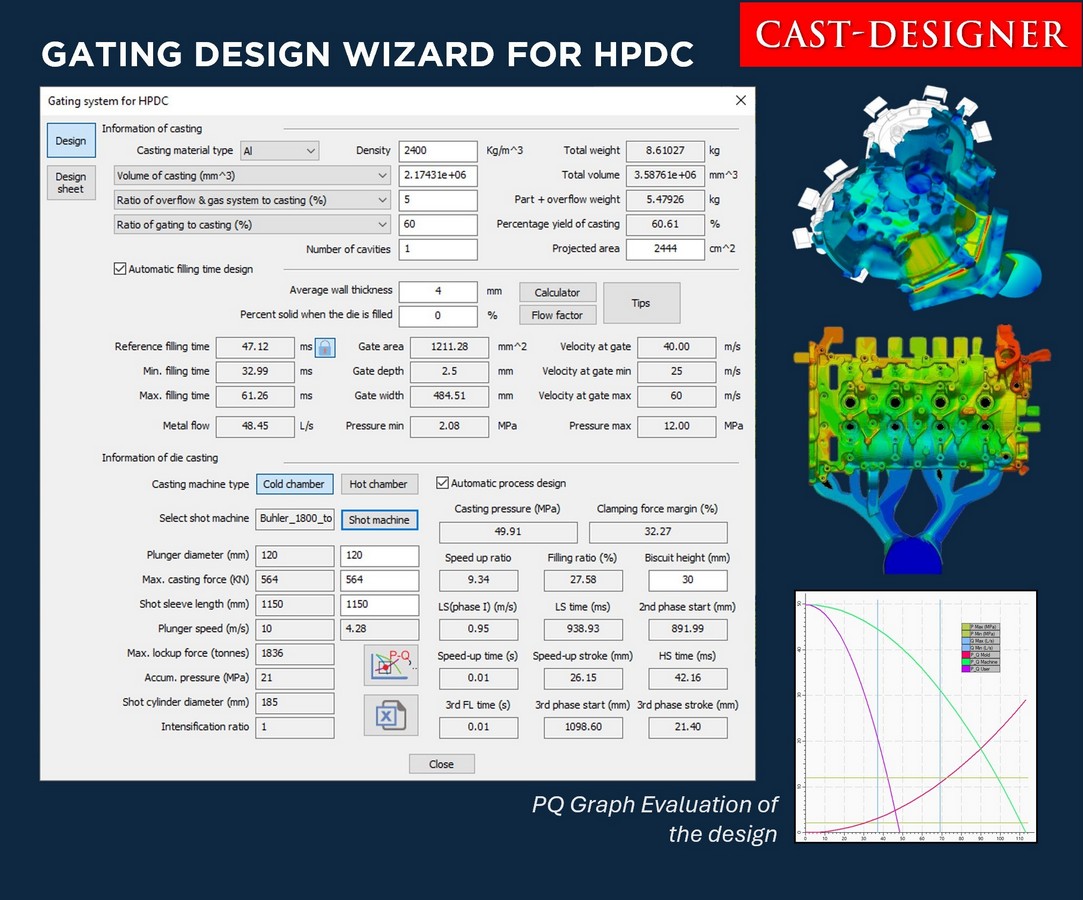
HPDC Gating Design Wizard

The HPDC Gating Design Wizard streamlines gating design by accepting key casting inputs and delivering optimized results quickly and accurately.

  • Inputs: casting weight, projected area, material, shot machine, and biscuit size.
  • Generates PQ graph to validate shot machine capacity.
  • Outputs include filling time, ingate velocity, required ingate area, phase velocities, and shift times.
  • Calculates casting pressure, clamping force margin, and runner cross-sections for Smart Runner Design.
  • Ensures fast, efficient, and reliable gating setup with minimal manual effort.

QuickCast Flow Simulation

QuickCast enables rapid flow simulation in minutes by simply placing ingates with a point, direction, and weight factor. Ideal for early-stage design, it helps optimize part orientation and gating layout quickly.

  • Fast simulation with minimal input
  • Visualizes flow from each ingate, flow length, filling time, gas entrapment, and last fill region
  • Supports up to 1-million mesh models in under 5 minutes
  • Reduces design iterations, time, and cost

QuickCast Flow vs CFD Flow Comparison

QuickCast enables rapid flow simulation in minutes by simply placing ingates with a point, direction, and weight factor. Ideal for early-stage design, it helps optimize part orientation and gating layout quickly.

  • Fast simulation with minimal input
  • Reduces design iterations, time, and cost

Create Runner CAD Geometry in Cast-Designer

Casting Simulation Services
Runner Centre Lines

Place Sprue. To create runner, select an ingate (created in previous step) and pick a point towards sprue, runner automatically created as per width of the ingate size.

Casting Simulation Services
Auto Runner Sections

select other ingates and points of the desired location of the runner on screen, runner automatically created with correct width, draft, height as required for the ingate

Casting Simulation Services
Auto Runner in 3D

View runners in 3D, runner section width and height gradually reduced with proper draft angle. Each runner width is as per the width required for the ingate.

Casting Simulation Services
Auto Merge Runners

Select 1st runner as master and select 2nd to merge, runner section of the 1st runner automatically adjusted where 2nd runner is merging. Similarly in the other side runners.

  • Create fully parametric 3D runners in Minutes. From defined ingate and biscuit positions, our system auto generate a complete 3D runner system that seamlessly connects ingates and biscuits.

COMPLEX 3D RUNNER GENERATION USING 3D PROJECTION

Cast-Designer simplifies complex 3D runner creation using its built-in ParaCAD system. Just define the workspace, build the 3D die face and addendum, and use the 3D runner projection tool to generate a CAD-based 3D runner system with ease.

  • Features like ingate, overflow also follows the 3D profile

FastCooling Simulation Example

RED colored region indicates thick region and as well as that cooling is not sufficient, may leave a shrinkage porosity

FastCooling Simulation

Optimize Cooling System Design

Cast-Designer revolutionizes cooling system design with SmartCooling and FastCooling, enabling rapid analysis during the early design stage without requiring full mold geometry or detailed HTC data.

  • Get cooling analysis results in just 3-5 minutes using casting and cooling channel geometry.
  • Modify cooling layout or parameters and instantly evaluate the effect on casting thermal performance.

This fast, geometry-based approach helps reduce development time, improve product quality, and extend die service life.

Artificial Intelligence Tools: SmartCooling

SmartCooling automates die casting cooling system design using AI to create optimized, efficient cooling layouts. The process is 10-30x faster than traditional methods and follows a powerful 3-step approach:

Step 1: Define Cooling Regions & Materials

Assign key regions based on metal flow up to 6 main zones and 24 sub-regions. Set casting/mold materials, cooling properties, and production targets. This forms the foundation for intelligent cooling layout planning.

Step 2: Auto Generate Cooling Channels

The AI engine uses defined parameters to auto-generate a complete cooling system with parametric 3D geometry supporting both standard and jet cooling types. This is the core of SmartCooling intelligence.

Step 3: Optimize Cooling Channels Design

Run FastCooling Analysis to evaluate performance. Instantly see the effect of any changes in channel design, position, or cooling power enabling fast, data-driven optimization and design decisions. An Larger Example shown above.

Media Flow in Cooling Channels

In complex cooling systems, media flow within the channels can be quite intricate. Performing a thermal and flow simulation provides a detailed examination of both the media flow and temperature distribution. Furthermore, the dynamic heat transfer coefficient (HTC) can be derived from the results of the simulation, which can be used in the most accurate Full-Mould Cyclic Flow-Solidification Simulation.

Step 1: Define Media Inlets & Outlets

Assign all key parameters for the flowing medium hot or cold

Step 2: Get Media flow inside cooling channels with dynamic HTC value

Complex cooling system in GIGA casting, now can be effectively optimized.

Die-Spray Optimization: Boost Die Life & Efficiency

Die-spray is crucial in die casting poor spray causes thermal shock, die damage, and downtime.

  • Protects critical die areas and reduces maintenance
  • Extends die life and improves casting quality
  • Simulates nozzle positions, spray timing, die temperature, and surface shape
  • Ensures optimal spray coverage and cooling balance
  • Enhanced Accuracy: Generates dynamic HTC for precise full-cycle simulation and better process control

Part Ejection Simulation

Die casting part quality can be affected during ejection, where parts separate from mold surfaces under force.

The ejection force depends on metal shrinkage and friction at the contact surfaces. Since ejection happens quickly, the static friction coefficient is key to accurate simulation.

Simulation Highlights:

  • Full mold stress simulation: Solidification + Stress with contact pressure
  • Supports solid or shell models
  • Couples with Cast-Works/CDPE for ejection process analysis
  • Outputs: Ejection time, casting temperature, residual stress, contact pressure

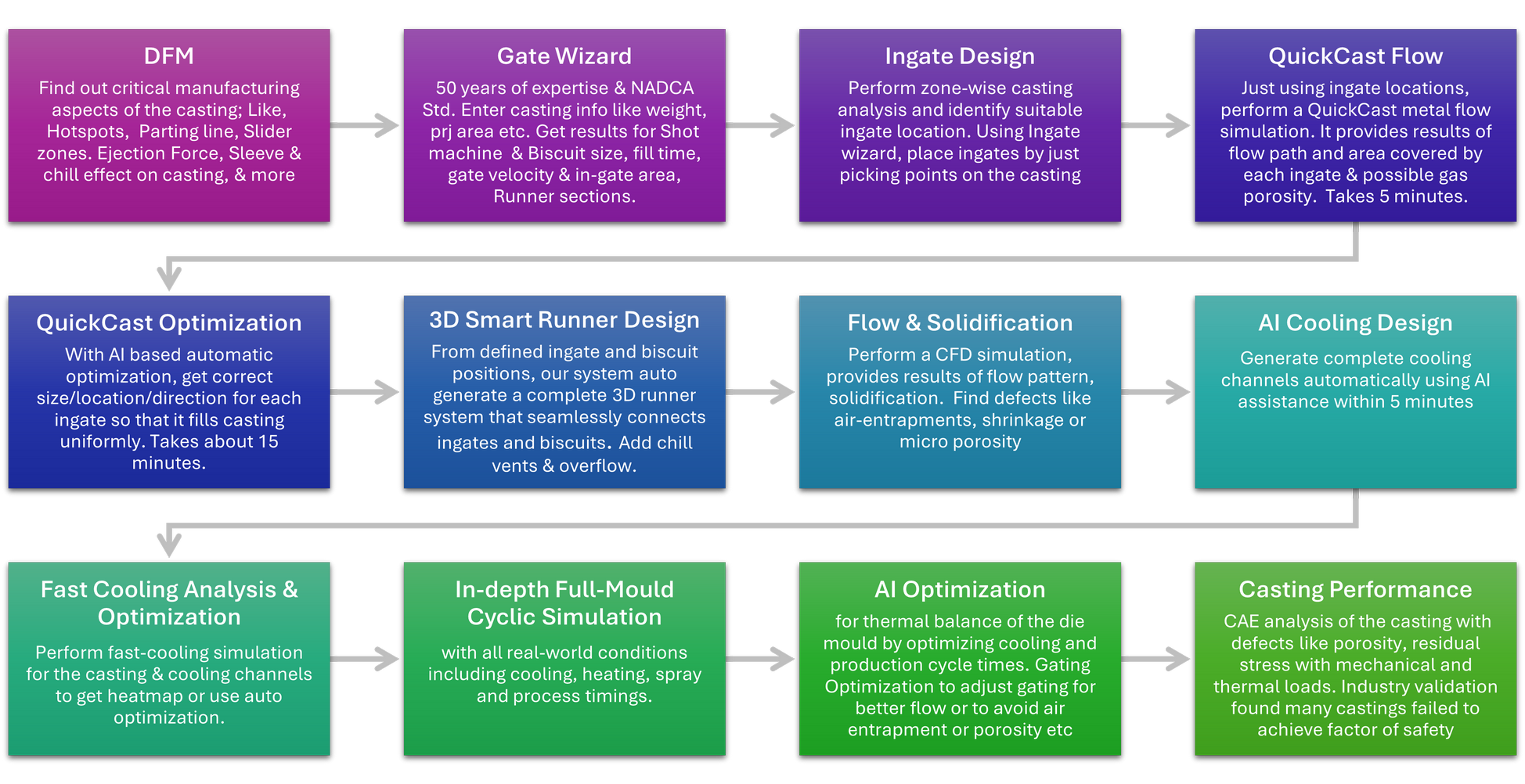
Cast-Designer for HPDC - Gating Design to Simulation Process Flow

Cast-Designer HPDC Gating Design Process Chart

Frequently Asked Questions

What is Cast-Designer software used for?

Cast-Designer is a comprehensive casting simulation and optimization software used by foundry engineers and designers. It helps in gating system design, defect prediction, solidification analysis, and process optimization for various casting processes.

Which casting processes does it support?

Cast-Designer supports a wide range of casting processes including High Pressure Die Casting (HPDC), Gravity Casting, Sand Casting, Investment Casting, Low Pressure Die Casting, and Squeeze Casting.

What are the system requirements?

The software runs on Windows 10/11 64-bit systems. Minimum requirements include 16GB RAM (32GB recommended), a dedicated GPU with 4GB VRAM, and an Intel i7 processor or equivalent. SSD storage is recommended for better performance.

Is there a trial version available?

Yes, we offer a 30-day fully functional trial version. You can request it through our website, and our technical team will assist you with the installation and provide basic training if needed.

What kind of support do you offer?

We provide comprehensive support including email support, remote assistance, on-site training (optional), and regular software updates. Our support team is available during business hours with emergency support for critical issues.

Some of the Casting Simulation Results

  • Flow Velocity

    Flow Velocity

    In casting simulations, flow velocity is crucial for predicting how molten metal fills the mold. It helps identify issues like air entrapment, turbulence, and cold shuts, ensuring smooth flow, better mold filling, and improved casting quality.

  • Sample Image 2

    Flow Temperature

    In casting simulations, flow temperature is vital to ensure proper mold filling and solidification. It helps detect risks like cold shuts, misruns, and uneven cooling, enabling optimized gating design and improved casting integrity, surface finish, and mechanical properties.

  • Sample Image 3

    Air Enrapment

    In casting simulations, air entrapment indicates where air may get trapped during metal flow. Monitoring it helps prevent porosity, blowholes, and incomplete filling. Identifying air pockets early allows for better venting and gating design, improving overall casting quality and reliability.

  • Sample Image 4

    Flow Velocity Vector

    In casting simulations, flow velocity vector direction shows the path and behavior of molten metal within the mold. It helps identify turbulence, short-circuiting, and uneven filling, guiding gating system optimization to ensure smooth, uniform flow and high-quality castings.

  • Sample Image 5

    Fill Time Plot

    In casting simulations, the fill time plot shows how long molten metal takes to fill the mold cavity. It helps identify slow-fill zones, cold shuts, and misruns, enabling optimization of gating design for balanced filling, better quality, and defect prevention.

  • Sample Image 1

    Flow Oxides

    In casting simulations, the flow oxides plot highlights areas where oxides may form due to turbulent metal flow. This helps detect risks of inclusions, weak spots, and surface defects, allowing engineers to refine gating and pouring to minimize oxidation-related issues.

  • Sample Image 2

    Maximum Air Pressure

    In casting simulations, the maximum air pressure regions plot identifies areas where trapped air builds up during mold filling. High air pressure can lead to blowholes, porosity, or incomplete filling. This plot guides venting and gating improvements to enhance casting quality.

  • Sample Image 3

    Materail Trace Lines

    In casting simulations, the material trace lines plot tracks the path of molten metal during filling. It helps visualize flow patterns, detect dead zones, and analyze mixing behavior, enabling better gating design and ensuring complete, uniform filling for high-quality castings.

  • Sample Image 4

    Solidification

    In casting simulations, solidification analysis reveals how and where molten metal solidifies in the mold. It helps identify shrinkage defects, hot spots, and non-uniform cooling, allowing optimization of riser design and cooling rates to improve casting quality and integrity.

  • Sample Image 5

    Shrinkage Porosity

    Shrinkage porosity indicates areas where metal volume loss during solidification can create voids. Identifying these zones helps optimize riser placement, cooling rates, and solidification patterns, ensuring sound castings with improved structural integrity and reduced internal defects.

  • Sample Image 1

    Niyama Mirco-Porosity

    Niyama micro porosity predicts the likelihood of micro-porosity formation based on cooling rates and solidification conditions. It helps identify potential defects in fine details, enabling adjustments in gating, cooling systems, and mold design for improved casting quality..

  • Sample Image 2

    SDAS

    Secondary Dendrite Arm Spacing result reveals the cooling rate and solidification structure of the metal. It helps predict material strength, ductility, and defect formation, guiding process adjustments to optimize casting quality and mechanical properties.

  • Sample Image 3

    Tensile Strength

    Tensile strength results predict the material's resistance to deformation under stress. Analyzing these results helps identify potential weak points, optimize alloy composition, and adjust process parameters to ensure castings meet required mechanical properties and performance standards.

  • Sample Image 4

    Mould-Casting Gap

    Mold-casting gap formation during solidification indicates areas where metal shrinks as it cools, potentially leading to misruns or voids. Analyzing this gap helps optimize mold design and riser placement, ensuring complete fill and defect-free castings.

  • Sample Image 5

    Casting Crack Indicator

    The casting crack indicator highlights areas at risk of cracking due to thermal stresses or poor solidification. Identifying these regions helps optimize cooling rates, riser placement, and gating design, preventing cracks and improving casting integrity.

  • Sample Image 1

    Casting Warpage

    Casting distortion/warpage predicts deformation due to uneven cooling or residual stresses. Identify areas prone to shape changes, enabling process adjustments like cooling rate optimization and mold design modifications to prevent dimensional issues and ensure accuracy.

Casting Simulation Services
🏆 Authorized Master Distributor - India

Casting Simulation Services
C3P Cast-Designer | HPDC | Sand Casting

Casting Flow, Solidification, Stress Simulation. Reduce defects, improve yield, and optimize your casting process with advanced simulation. Expert support for Aluminum, Magnesium, Zinc, Cast Iron & Steel alloys.

  • 30-50% Scrap Reduction
  • 15-30% Yield Improvement
  • 20-40% Die Life Extension
  • 40-60% Faster Time to Market
Request a Demo →

NESTech Services and Products

Why Choose NESTech as your CAD CAE Partner?

+ Drawings Created
+ Simulations done
+ Team Members
+ Years of Experience
Experience Icon

RICH EXPERIENCE

We bring 25+ years of rich experience to every project, ensuring exceptional results and unparalleled reliability.

Delivery Icon

ON-TIME DELIVERY

With meticulous planning, streamlined processes, and a dedicated team, we ensure that every project is completed promptly and efficiently

Teamwork Icon

EXCELLENT COLLABORATION

We foster a culture of teamwork, communication, and mutual respect, ensuring that every project benefits from the diverse perspectives and expertise of our team members.

Cost Icon

COST EFFECTIVENESS

With a multitude of projects Completed and catering to various industries, we have demonstrated excellent business results at lower cost with our domain expertise.

Some of the Cast-Designer Software Customers